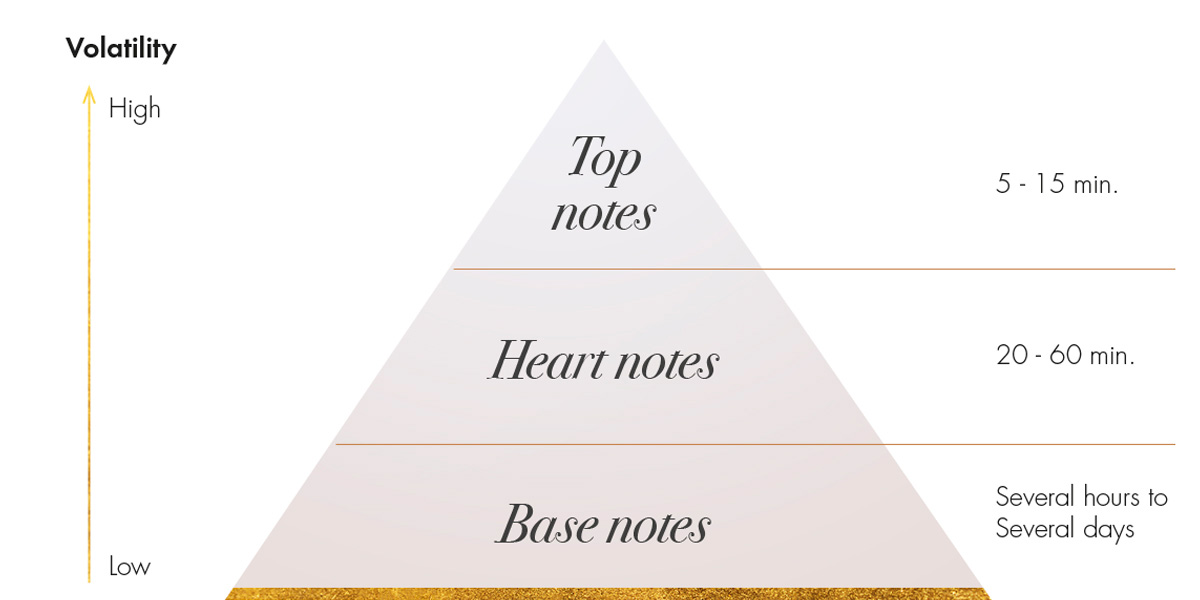
What is fragrance pyramid?
by Verano Fragrance almost 3 years ago
The pyramid is a classic visual structure, first proposed by perfumer Jean Carles. Marketers use it to denote the composition of a fragrance.
The pyramidal shape is intended to visually represent the unfolding process of the composition.
Conventionally, the pyramid is divided into three phases: the top (initial, starting, "head"), the middle ("heart," central), and the bottom (base).
Components are usually distributed across the phases based on physical characteristics (primarily volatility), which makes it possible to represent how the fragrance will develop over time.
Typical top notes can be highly volatile substances, for example citrus accords, as well as green, floral, some spicy notes, etc.; Typical base notes include substances with low volatility (resins, balms, leather, woody accords, etc.).
Although the olfactory pyramid is currently the most common way to describe a perfume composition, its actual usefulness is greatly exaggerated. This is because it does not reflect the actual composition of the fragrance (not all components used in the composition are listed in the pyramid), and sometimes it can be misleading since from the first seconds a perfume smells of all its components at once, gradually losing the more volatile ones.
Modern perfumers have long abandoned the pyramid structure and explore new forms when constructing compositions.
Fragrances can be without top, middle and base notes. In this case, the pyramidal structure doesn't work, and other conditional notations replace it, such as "crystal" (single note without change and disclosure) or "star" (constant support of the central meaningful note with the help of auxiliary elements with various characteristics), and so on.